
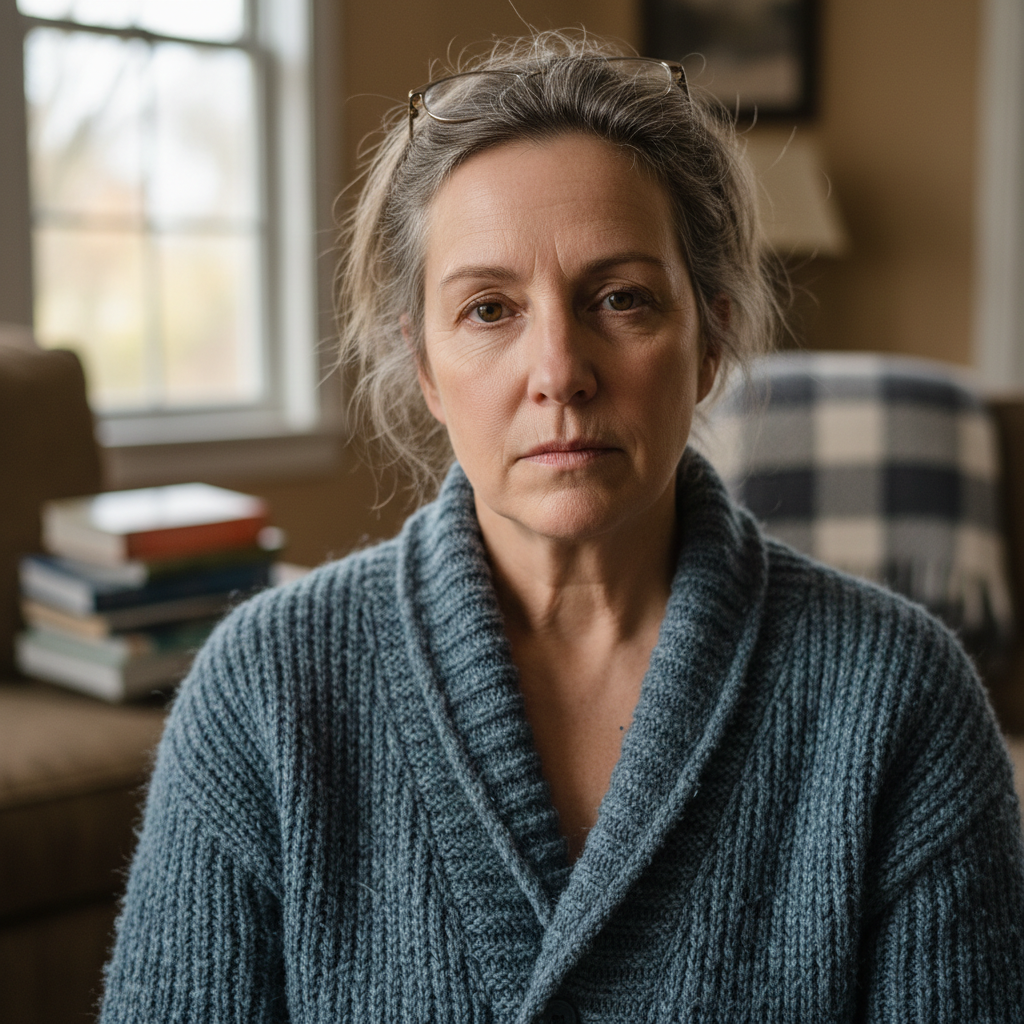
You’re caring for someone whose bones are thinning.
Who’s caring for you?
Marrow is a quiet service that wraps around the families carrying the invisible weight of brittle bones. We answer the questions you’re searching at midnight — and then we sit with you while you figure out the rest.
“Will Mom break a hip if she falls again?”
The fear is real, and it’s not catastrophizing — it’s pattern recognition. A second fracture after a first one is significantly more likely, especially if the underlying bone density hasn’t been addressed. But likelihood is not destiny.
Hip fractures in people with osteoporosis carry serious consequences: roughly 20–30% of older adults who fracture a hip don’t return to their pre-fracture level of independence. That number is sobering. It’s also why the work you’re doing right now — reading this, planning, asking questions — genuinely matters.
Ask her doctor: “Has she had a DEXA scan in the last two years? And based on her T-score, what fracture risk does she carry?” That question alone will change the quality of the conversation you have in that exam room.
“The first time I asked about her T-score the doctor actually paused and said — that’s exactly the right question. We’d been talking around it for two years.”
Margaret O., daughter and primary caregiver — Denver, CO
“How do I fall-proof her bathroom without making her feel like a patient?”
This is one of the most common things we hear — and the tension is real. You want to install grab bars. She sees a hospital room. The modifications that could protect her spine also signal to her that something has changed, and that change feels like loss.
The framing matters more than the hardware. Lead with her preferences, not your fear. “I found these matte black grab bars that look like towel racks — can I show you?” is a different conversation than “We need to make some safety changes.”
- Grab bar at toilet (floor-to-ceiling tension bars need no drilling)
- Non-slip mat inside and outside the shower — not just a bath mat
- Handheld showerhead (reduces the need to reach or twist)
- Shower chair or bench for low-energy days
- Nightlight on the path from bed to bathroom
- Remove the bath rug entirely — they slip and they catch feet
Our full 30-Day Fall-Prevention Checklist covers the bathroom in detail alongside every other room. Download it free below — it’s designed to be walked through together, not handed over as a list of problems.
“How do I talk to her doctor about denosumab — and why won’t they just explain it?”
Denosumab (Prolia) is a biologic injection given every six months that slows bone loss by interrupting the cells that break bone down. It’s one of the most effective osteoporosis treatments available — and it’s also one of the most consequential to stop. Missing a dose isn’t like missing a vitamin. A rebound effect can cause rapid bone loss and vertebral fractures.
Doctors don’t always explain this because they assume the patient will comply. As the caregiver, you need to know it — because you’re the one who will notice if an appointment gets missed.
- “Is she on denosumab, a bisphosphonate, or something else — and why that one?”
- “What happens if she misses a dose or an injection appointment?”
- “Is her calcium and vitamin D supplementation appropriate for this medication?”
- “At what point would you recommend transitioning to a different treatment?”
- “Can I be added as a contact on her care record for medication reminders?”
You don’t need to be a pharmacist to ask good questions. You need to be the person who writes them down before the appointment and reads them out loud in the exam room. That’s the job.
“I’m suddenly the one cooking. What should she actually be eating?”
The calcium-through-food conversation is more nuanced than the supplement aisle would suggest. For someone on denosumab especially, adequate calcium and vitamin D aren’t optional — hypocalcemia (low blood calcium) is a known risk, and diet is the first line of defense.
The goal isn’t a complicated meal plan. It’s building a few reliable anchors into the daily rhythm — a yogurt at breakfast, a leafy green at lunch, a piece of salmon twice a week — and not treating it as a project that needs to be perfect.
If cooking has become a second job on top of everything else, that’s worth naming in your care plan. We can help you think through what to simplify.
Get Your Care Plan Started
Tell us a little about your situation. A Marrow coordinator — a real person, not a bot — will reach out within one business day. There’s no script and no sales call. Just a conversation.
The questions shift now. From logistics to survival. From what to do to how to keep going.
“Is it normal to feel this angry — at her, at the situation, at everyone who isn’t helping?”
Yes. Without qualification, yes.
Caregiver anger is one of the most common and least discussed experiences in this work. It doesn’t mean you love her less. It doesn’t mean you’re a bad person or a bad caregiver. It means you are carrying something genuinely heavy, and your nervous system knows it even when you’re performing calm.
The anger usually has layers: grief underneath it (she’s changing), fear underneath that (what happens next), and exhaustion underneath everything. The anger is often the only feeling that has enough energy to surface.
We hold space for this in care planning conversations. You don’t have to perform wellness or gratitude to work with us. You can arrive exactly as tired and frustrated as you are.
“I told the Marrow coordinator I was furious at my father for falling in the first place. She didn’t flinch. She just said — tell me more about that. I cried for about ten minutes and then we made a plan.”
David K., son and sole caregiver — Portland, OR
“I live 45 minutes away. Am I close enough? Is that too far?”
Distance caregiving is its own particular kind of exhaustion — the constant low-grade vigilance, the mental load of monitoring from afar, the guilt that spikes every time your phone rings with an unknown number. Forty-five minutes feels like nothing when she’s fine. It feels like a continent when she’s not.
There is no correct distance. What matters is whether you have a system that can hold the space between your visits — a neighbor with a key, a medication reminder app, a local aide with your number, a protocol for what happens if she doesn’t answer by 10am.
- Primary contact: One neighbor or building manager with a key and your number
- Medical alert: A wearable she’ll actually wear — not the one you chose, the one she chose
- Check-in rhythm: A daily text or call with a clear “I’ll call again if I don’t hear from you” protocol
- Local backup: One person (friend, aide, neighbor) you can call before you drive
- Documented plan: What do you do if she falls and can’t reach the device?
We help families build this infrastructure in care planning. It doesn’t eliminate the anxiety. But it converts ambient dread into a specific, manageable plan — and that changes how it lives in your body.
“What do I do when I’m running on empty and she still needs everything?”
Caregiver burnout is not a character flaw. It’s a predictable physiological response to sustained, high-stakes, emotionally complex labor without adequate recovery. The fact that you’re still showing up doesn’t mean you’re fine. It often means you’ve learned to function in a depleted state so effectively that no one notices — including you.
The standard advice — “take care of yourself first” — is well-intentioned and largely useless when you have no time, no coverage, and no one to hand the phone to. What actually helps is structural, not motivational.
- Identifying one task you are currently doing that someone else could do
- Building in a scheduled, non-negotiable 48-hour window each month where you are not the primary contact
- Naming your burnout level to one person — a friend, a sibling, a coordinator — so it’s no longer invisible
- Finding out whether your parent qualifies for respite care under Medicare or Medicaid
- Getting your own care plan — not just hers
The last point is the reason Marrow exists. Not just to help you manage her care better. To make sure someone is tracking how you’re doing in the process.
“I didn’t realize I was in crisis until someone asked me directly how I was sleeping. Not how Mom was sleeping. Me. I hadn’t been asked that in over a year.”
Priya S., daughter and caregiver coordinator — Austin, TX
The 30-Day Fall-Prevention Checklist
A room-by-room walkthrough designed to be done together — not handed over as a list of problems. Covers the bathroom, bedroom, kitchen, entryway, and outdoor spaces. Includes a conversation guide for when she pushes back.
What’s inside
Enter your email — we’ll send the PDF immediately.
One email. The PDF. Nothing else unless you ask.